Relocating to Miami? What Nobody Tells You
Are You Thinking of Making Miami Your Next Home?
If Miami is on your horizon, you've probably seen the postcard version: sunshine, beaches, and a skyline lit up at night. That version is real. It's just not the whole picture.
I relocated to Miami myself, and I haven't regretted it a single day. But a few things caught me by surprise, and I know from working with relocation clients that I'm not the only one. Before I moved, I had all the same questions you might have right now. Am I making the right decision? What will it actually be like to live here? Is it the same as being on vacation?
Below are ten things worth knowing before you take that big step. Some are practical (taxes, transportation, where "Miami" actually starts and ends), some are cultural, and a few are the kind of thing nobody mentions until you've already signed a lease. Take them together, and you'll have a much clearer sense of whether Miami fits the way you want to live.
1. Miami Is Not All of South Florida
This one sounds obvious, but it's one of the most common misconceptions I run into, and it matters a lot when you start looking at property.
When people say "Miami," they often mean all of South Florida. In reality, Miami (Miami-Dade County) runs from Homestead in the south up to Aventura in the north. Aventura sits right on the border between Miami-Dade and Broward County. Once you head farther north, you're in Broward, which has its own cities, its own character, and its own appeal. It's a great area, but it's not Miami.
Why does this matter? Because county lines affect more than your mailing address. They shape your property taxes, your school options, your commute, and the overall feel of daily life. The distance is real, too: driving from Homestead to Aventura can take roughly an hour or more depending on traffic. So if someone tells you a home is "in Miami," it's worth confirming exactly where it sits on the map before you fall in love with it
2. There Is a Neighborhood for Every Kind of Life
One of the things I love most about this city is that no two neighborhoods feel the same. Miami is known for its beaches, but not everything here revolves around the ocean. It depends on the vibe you're after, and there's a place for almost everyone.
A few examples to get you oriented (drive times are approximate and can stretch considerably during rush hour):
Wynwood
Wynwood is the artsy one: murals on every wall, galleries, creative studios, and a lively restaurant and bar scene. It's centrally located, roughly 15 minutes from Miami International Airport, about 15 minutes to Miami Beach, and around 10 minutes to Brickell.
Coral Gables
Coral Gables is historic and refined, with Mediterranean-style architecture, tree-lined streets, and walkable spots like Miracle Mile. It's about 15 minutes to the airport, roughly 15 to 20 minutes to Brickell, and around 30 minutes to Miami Beach.
Coconut Grove
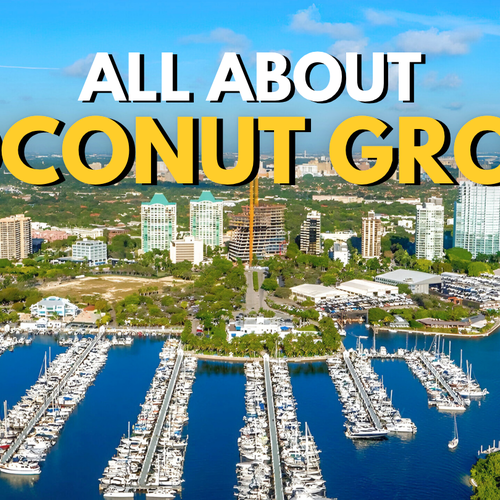
Coconut Grove blends a younger energy with a lot of history, plus lush greenery, waterfront access, and great schools, which makes it popular with families. It's roughly 15 to 20 minutes to the airport, about 10 to 15 minutes to Brickell, and around 30 minutes to Miami Beach.
Brickell
Brickell is often called the mini New York of Miami: high-rises, the financial district, walkable dining, and a cosmopolitan pace. It's about 20 minutes to the airport and about 20 minutes to the beach.
Downtown Miami
Downtown is an up-and-coming, developing neighborhood right next to Brickell, with waterfront parks, arts and culture, and plenty of new construction. It's roughly 15 minutes to the airport, about 15 minutes to Miami Beach, and just a few minutes to Brickell.
The Beach Neighborhoods
If you're more laid-back, there are neighborhoods by the beach where the pace slows down and mornings start with the water.
Every neighborhood question is really a fit question: does the way you live match the way the neighborhood lives? Picture your ideal Saturday. Is it a gallery walk and a new restaurant in Wynwood? A coffee under the trees in the Grove? A sunset on the bay from a Brickell balcony? Your answer will point you in the right direction.
3. The Cost of Living Has a Wide Range
Yes, Miami has been in the headlines for rising housing prices. Prices here have climbed 40%, 50%, even 60%. Of course, costs have gone up across the United States, and Miami isn't the exception.
What that headline misses is just how wide the range is here. You can find homes in the $400,000s and $500,000s, and you can find properties all the way up to $54 million. There are very affordable neighborhoods that are convenient and appealing, and there are neighborhoods built for higher budgets.
What does that mean for you? Miami isn't one price point. It's a city with options across salaries, expenses, and housing, which means you can shape your move around your own budget rather than someone else's. The key is knowing which neighborhoods line up with your numbers and your lifestyle, and that's exactly the kind of conversation worth having before you start touring.
4. There's No State Income Tax (and There's a Homestead Exemption)
Let me tell you something: who loves taxes? I don't think anyone truly does. Florida doesn't have a state income tax, and honestly, that was one of the main reasons I decided to move to Miami.
There's a second benefit that matters if you buy a home: the Homestead Exemption. It can reduce the taxable value of your property by up to $50,000 if you're a resident and the home is your permanent residence as of January 1st of the year you apply.
In plain language, that exemption can lower the property tax bill on the home you actually live in. It doesn't apply to investment properties or second homes you don't live in full-time, so it's worth planning your purchase timeline and paperwork around it if you're buying a primary residence. The details can depend on your situation, so it's a good idea to confirm eligibility with the county property appraiser or a tax professional.
5. Public Transportation Isn't Miami's Strong Suit
Here's one of the not-so-great parts. Local public transportation in Miami isn't as reliable as what you'd find in cities like New York or Chicago.
Things have improved in some ways. Brightline, the high-speed rail, now runs all the way up to Orlando, but that's really for long-distance travel. For getting around town, there are options: the Metromover and Metrorail serve areas like Brickell and Downtown, and there are trolleys and Metrobus routes too. The challenge is consistency. They aren't always on time, and when it rains (which, in Miami, it does), things can get complicated.
What this means for you: in most of the city, you'll likely want a car. If car-light living matters to you, it depends on the neighborhood. Areas like Brickell and Downtown give you the most transit and walkability, so factor that into your search early.
6. We Don't Speak English or Spanish. We Speak Spanglish.
Miami has a big Spanish-speaking and Latin community. The latest figure I've seen puts it at around 70% of the population. Some people here don't speak English at all.
That makes knowing Spanish very handy for getting around day to day. In some jobs and career paths, it's close to essential. If you don't speak Spanish yet, I'd encourage you to see this as an opportunity rather than an obstacle. Living here is one of the best ways to immerse yourself in another language, and you'll pick up more than you expect just by ordering your cafecito every morning.
7. Get Used to "Miami Time"
This is the one people struggle with the most, and I say that with love. Latins, and Miami in general, tend to run late. Meetings, dinners, events, and especially parties rarely start exactly on time.
If you're invited to a party at 5:00 p.m., don't show up at 5:00 p.m. It probably won't really get going until around 6:30. We call it Miami time, or Latin time.
At the beginning, some newcomers find this stressful or even frustrating. My advice: take a breath and adapt. Once you understand the rhythm, it becomes part of the charm. Just build a little flexibility into your social calendar.
8. The Lifestyle Is So Much More Than Beaches and Parties
Search "Miami" online and you'll mostly see beaches and nightlife. That's a big misconception. The party scene is here, and it's incredible, but it's far from the whole story.
Personally, I'm not too much into the party scene. I go here and there, because why not, but what I love most about Miami is the wellness culture. This is a city built for taking care of yourself: sunrise and sunset yoga, cycling classes, kayaking, organic food, and all kinds of outdoor activity nearly year-round.
Think about starting your morning with yoga as the sun comes up over the water, grabbing a fresh açaí bowl, and still having time for a kayak session before the heat of the day. That's a regular weekday here for a lot of people.
And if you do love to go out, you're covered. Miami has world-class nightclubs and a huge range of music, from techno to, of course, Latin music.
9. Nature and Wildlife: No Mountains, Plenty of Water (and Some Reptiles)
Yes, you may have heard the stories. We have lizards, we have iguanas, and yes, we have alligators. Miami sits right next to the Everglades, so wildlife is simply part of life here. Occasionally one shows up somewhere unexpected, even at a doorstep. I haven't had that experience myself, thank goodness, and it's not like you'll open your door every morning to find an alligator waiting. Some cities have bears; we have alligators.
Another thing to know: Miami is completely flat. There are no mountains, so if hiking is a big part of your life, this isn't the city for it. What you get instead is water, and lots of it. Boating, paddleboarding, kayaking, and all kinds of water sports are right at your fingertips.
That's an honest trade-off worth thinking about. If your ideal weekend is a mountain trail, you'll be traveling for it. If it's a day on the water, you'll feel right at home.
10. Festivals, Events, and a Serious Sports Scene
Miami is known for internationally recognized events like Art Basel and major fashion shows. But beyond the headline events, there's a steady rhythm of local life: farmers markets, wine events, concerts, and community festivals throughout the year.
Sports are a big part of the city's identity too. We have the Miami Dolphins, the Miami Heat, and the Miami Marlins, plus Inter Miami, the soccer club co-owned by David Beckham, with Lionel Messi on the field. Formula 1 has also made Miami one of its stops, which brings a wave of international energy to the city every year.
For anyone who loves sports, Miami has it all. And the growth of the sports scene is one more sign of how much the city has evolved and how much it has to offer residents, not just visitors.
What This Means for You
If You're Buying
Start with the map and your lifestyle, not just the listings. Confirm whether a property is truly in Miami-Dade or in Broward, think about how you'll get around, and match your budget to the neighborhoods that fit it. If the home will be your primary residence, plan ahead for the Homestead Exemption.
If You're Renting First
Renting for a while can be a smart way to test a neighborhood before committing. It gives you time to experience traffic patterns, rainy-season transit, and the day-to-day feel of an area before you buy.
If You're Investing
Miami's wide price range and the pull of its lifestyle, events, and sports scene are part of what draws people here. Just remember that the tax and exemption picture for an investment property is different from a primary residence, so run the numbers with that in mind.
If You Already Own a Home in Miami
If you've been thinking about making a move, whether that's upgrading, downsizing, or changing neighborhoods, it's worth knowing where your home stands today. Relocation is a big part of what keeps demand moving in this city. Let's have a conversation. No pressure, no commitment, just a real look at your options.
The Honest Summary
What people love: no state income tax, a Homestead Exemption for primary residences, a neighborhood for almost every lifestyle, a wide range of price points, a strong wellness culture, water right at your fingertips, and a busy calendar of events and sports.
The trade-offs: public transportation isn't very reliable, so you'll likely need a car; housing prices have risen; there are no mountains for hiking; wildlife is part of the deal; knowing Spanish helps a lot; and Miami time takes some getting used to.
Like every city, Miami has its pros and cons. Is it the right move for you? This isn't a hard yes or a hard no. It depends on how you want to live. For me, the answer was yes, and I'm happy here every single day.
Let's Make the Move Together
If you're looking to buy, sell, rent, or invest anywhere in Miami, please do not hesitate to reach out to me. All of my information is below. Send me a text, send me an email, give me a call, and I'll be more than happy to help you make the move.
And if you're not ready yet, that's completely fine. Whether your move is three months, six months, a year, or two years away, it's good to have a conversation early. I've been through the relocation process myself, and I understand the nerves and the questions that come with it. I'm here to help whenever you're ready.
Sign up: Newsletter & Market Updates
Ready to Discuss Your Real Estate Goals? Book a Consultation
Check out this article next
Living in Coconut Grove: Prices, Schools & Lifestyle
Is Coconut Grove the right Miami neighborhood for you?
Read Article